

MANIFESTO
By Rob Price, CEO, Youth Enrichment Brands
The Wake-Up Call
When I joined School of Rock nearly ten years ago, parents repeatedly uttered a phrase that stopped me cold: "School of Rock saved my kid." It happened so frequently that it demanded an answer to the obvious follow-up question: Saved them from what?
Sometimes these parents were speaking literally. They felt the School of Rock community helped assuage depression, anxiety, and suicidal ideation. More broadly, the culprit they were saved from was loneliness. Their child, who, before School of Rock, felt as though they didn’t belong anywhere and had no purpose, now felt a deeper sense of connection.
This phenomenon became even clearer to me when School of Rock became part of Youth Enrichment Brands. It was not just “the music kids” who were facing these challenges. Parents of our US Sports Camps, i9 Sports leagues, and SafeSplash Swim Schools made similar observations. They felt that they were in an endless battle to restore their child’s dwindling connection to meaning.
Ironically, this is a generation that has never been more wired together. But the parents I speak to share that their kids' worlds have been quietly and systematically redesigned for solitude. Their children turn to their devices for distraction, engagement, and reinforcement. They are addicted to this easily accessible replacement of “real-life” experiences. As is the case with all addictions, the compulsion grows, and the victim suffers. They suffer alone.
Much has been written about the deleterious effects of social media on kids. Below, I will highlight some of it. However, my mission is to move beyond the finger-wagging and restriction. Our challenge is to restore the real-world experiences that digital environments increasingly displace.
Doing so requires understanding the forces reshaping childhood, defining what healthy development looks like, identifying where children grow best, and intentionally creating more opportunities for those experiences.
Over the past decade, I've become convinced that healthy childhood ultimately produces three enduring outcomes: confidence, resilience, and joy. Every decision parents, schools, coaches, communities, and policymakers make should be evaluated through that lens. Are we helping children become more confident? More resilient? More joyful? That is the standard by which I believe every enrichment experience should be judged.
Digital Distress
The systems shaping childhood today were not built accidentally. Social media platforms and smartphones are built around a single incentive: to capture as much human attention as possible, for as long as possible, and monetize it. They are extremely effective and therefore particularly destructive when the humans in question are still developing the judgment, identity, and resilience they need to navigate it. In a highly engineered environment where heightened emotional responses and constant engagement are economically rewarded, real-world experiences in play, conversation, boredom, and expedition struggle to compete.
The consequences of this are well-documented. The U.S. Surgeon General's Advisory on Social Media and Youth Mental Health is unambiguous. While acknowledging that social platforms can offer connection and creative expression, the report warns of significant risks at the most sensitive stages of social and emotional development — social comparison, sleep disruption, anxiety, depression, cyberbullying, and body image issues, with effects that are notably more pronounced among teenage girls. The advisory notes that nearly 95% of teens use social media, with more than one-third using it almost constantly. The resulting damage is staggering, with the report citing research findings that adolescents using social media more than three hours a day face roughly double the risk of poor mental health outcomes.

Generative AI is accelerating the problem in ways we are only beginning to understand. What concerns me most is not that AI can write a student's essay or generate their artwork, though that also matters. It's that AI is blurring the line between what is real and what is manufactured, exposing children to synthetic influencers, deepfakes, and emotionally convincing but inauthentic interactions at an age when they are still developing judgment, confidence, and a stable sense of self. AI perpetuates the trends activated by social media and further replaces the time for self-reflection, real connection, and untethered exploration.
Children are increasingly outsourcing not only information, but imagination, problem-solving, and even companionship. The concern is not simply what AI can create. It is what children may no longer feel compelled to create for themselves.
Whether driven by social media or generative AI, the underlying problem is not simply screen time. It is displacement: the quiet, cumulative substitution of experiences that build character with experiences that merely consume attention. When a child spends three hours on a device, it is not just three hours of passive content. It is three hours that imitate a sense of connectedness but are void of social referencing, cooperative communication, and empathy-building that can come from a rehearsal, a practice, a lesson, a disagreement resolved face-to-face, or a recovery from a disappointment, rejection, or failure amongst peers. It is three hours of developmental infrastructure that went unbuilt.
The Achievement Trap
While digital technologies reshape childhood from the outside, another set of pressures often reshapes it from within.
Childhood has increasingly become a carefully managed résumé-building exercise filled with travel sports, tutoring, curated extracurriculars, constant supervision, and relentless performance pressure. In this environment, free play, boredom, independence, and unstructured social development are often displaced by optimization and achievement. Erica Komisar warns that “children need connection more than perfection,” arguing in her books Being There and Chicken Little: The Sky Isn’t Falling that emotional security and human attachment are foundational to resilience and long-term well-being. When childhood becomes dominated by competition and credential-building, children may achieve more on paper while becoming more anxious, fragile, and disconnected in the process. The irony is painful. Parents often sacrifice the very experiences that build resilience in an effort to secure their child's future.
Similarly, Jennifer Wallace describes this “toxic achievement culture” as an environment where children come to believe their value is tied primarily to performance, accomplishment, and external validation. In her work, she argues that many young people feel loved and valued more for what they achieve than for who they are, creating chronic pressure, anxiety, perfectionism, and fear of failure. As Wallace writes in her book Never Enough, “Kids who receive messages that they matter no matter what are more resilient, more self-confident, and more motivated from within.” Her research and others suggest that when self-worth becomes contingent on grades, rankings, athletic success, or social status, children are more vulnerable to depression, burnout, and emotional fragility.
Parents are thinking about college essays when their children are five years old. Kids are being funneled into single-sport specialization before they've had the chance to discover what they actually enjoy. A burned-out, highly skilled young athlete is not a success story. Neither is a child who has mastered playing an instrument they resent.
Parents are not drawn into a toxic achievement culture because they are shallow or status-driven, but rather by the fear of an increasingly competitive and uncertain world. In a culture that constantly signals that college admissions, elite opportunities, and future security depend on relentless optimization, even loving, well-intentioned parents can begin to equate constant achievement with protection, stability, and good parenting.
What compounds this is the way parental anxiety shapes how we praise. When children are admired primarily for outcomes such as a scored goal, a great grade, or a successful audition, they may conclude that love is conditional on performance. What we want instead is character-building admiration: praising the honesty in how they played, the patience they showed to a struggling teammate, the courage to try something new. Children need to be valued for who they are, not just what they do. The difference is not subtle. It shapes everything.
When parents' anxiety drives the curation of activities and their derived value, the real world is not revealed. A version of it is imposed. It can further reinforce the cycle of escape into digital displacement when a child finally has time within their full control.
Although digital displacement and toxic achievement culture appear different, they ultimately produce the same result: fewer opportunities for children to discover who they are through authentic experience.
The Response
The digital displacement from devices, social media, and AI requires an intentional, multi-front response. Naturally, the temptation is to look to regulation and restriction, and there are some promising ideas there.
Governments around the world are rapidly moving to restrict children’s access to social media. Australia enacted the world’s toughest law, requiring major platforms to block users under 16 beginning in late 2025, with steep fines for noncompliance. Across Europe, countries including Britain, France, Austria, Greece, and Spain are considering similar age-based restrictions, mandatory age verification, limits on addictive features like infinite scroll and notifications, and stricter safety standards for platforms serving minors. In the United States, at least 19 states have passed or proposed laws targeting “addictive feeds,” nighttime notifications, algorithmic recommendations, and parental consent requirements for minors, though many face constitutional challenges in court. Regulators are increasingly shifting away from simply warning parents toward holding technology companies directly responsible for designing safer digital environments for children.
Regulation of AI for children, although still in its infancy, is beginning to mirror the crackdown on social media. Policymakers in the U.S. and Europe are increasingly focused on restricting harmful AI chatbot interactions, requiring age verification, limiting emotionally manipulative “AI companion” systems, and combating AI-generated deepfakes involving minors. Regulators and educators are also raising concerns that generative AI could undermine critical thinking, authentic learning, and healthy emotional development, shifting the debate from simply managing screen time to questioning how AI should shape childhood itself.
Schools are increasingly rethinking the role of technology in childhood and learning, with many adopting stricter limits on phones, social media, and AI tools during the school day. Districts across the U.S. and Europe have introduced phone-free policies and screen restrictions after teachers reported rising distraction, anxiety, social conflict, and declining attention spans. Many educators believe constant digital stimulation undermines focus, resilience, and face-to-face interaction.
Schools are also struggling to define boundaries for generative AI. Some initially banned tools like ChatGPT over concerns about cheating and weakened critical thinking, while others now allow limited educational use under supervision. Increasingly, the debate is becoming less about technology itself and more about how to preserve human connection, curiosity, and deep learning in an intrusively digital world.
Regulation and Restriction Isn’t Enough
Often, legislative consensus is labored and delayed. Further, even when the most perfect guardrails are provided, our children will crash into or right through them. Limit testing and rule-breaking are fundamental to child development. And simply turning off toxic achievement culture is easier said than done.
As rules get written, parents have three powerful forces at their disposal which technology cannot overwhelm: confidence, resilience, and joy. When the combination is right, kids will thrive.
Confidence: Confidence begins with safety: when children feel physically and emotionally secure, they are more willing to take constructive risks, try new things, and grow. Great coaches and instructors meet kids where they are, creating environments where every child can develop proficiency through practice, encouragement, and achievement at their own pace. Just as importantly, children thrive when they feel they belong. A sense of acceptance and inclusion becomes the foundation for deeper engagement, stronger participation, and lasting self-confidence. And critically, competence produces confidence. Children do not need to be excellent. Capability—not superiority—is the foundation of lifelong confidence. That sense of competence, built through practice and real-world challenge, is more predictive of life satisfaction than any ranking or trophy.
Resilience: We also believe resilience is developed through experience, not perfection. New activities and challenges teach children how to initiate, adapt, improvise, and persevere. By encouraging experimentation, we help kids see setbacks not as failure, but as part of the learning process. Meaningful growth requires frustration and challenge. Children gain resilience when they discover that effort, persistence, and discomfort often precede progress. Exposure to a broad range of enrichment experiences also fuels curiosity, giving children the opportunity to discover new interests, uncover hidden strengths, and develop passions that can shape their lives.
Joy: Above all, childhood should be joyful. Fun is not a distraction from development. Children stay engaged, motivated, and open to growth when experiences are enjoyable and rewarding. Lasting memories are also built through connection: friendships, mentorships, teamwork, and shared experiences create emotional bonds that shape identity and well-being.
This solution is inadequate if it only reaches some children. The families who need these experiences most are often the ones with the least access to them. Things outside of a kid's control should not determine whether they get to experience the confidence of finishing a race, the resilience of getting back onstage after a hard rehearsal, or the simple joy of belonging to a team. Expanding access to these programs is a fundamental component of this work. While local, state, and national policymakers look at regulation, we need as much focus on affordable programming, safe facilities, and widespread adult mentorship. At Youth Enrichment Brands, we support Play Without Limits - a nonprofit that helps lower-income families expose their kids to developmental experiences. Many other worthy organizations need our support to make the power of play universal.

The Architecture of Healthy Enrichment
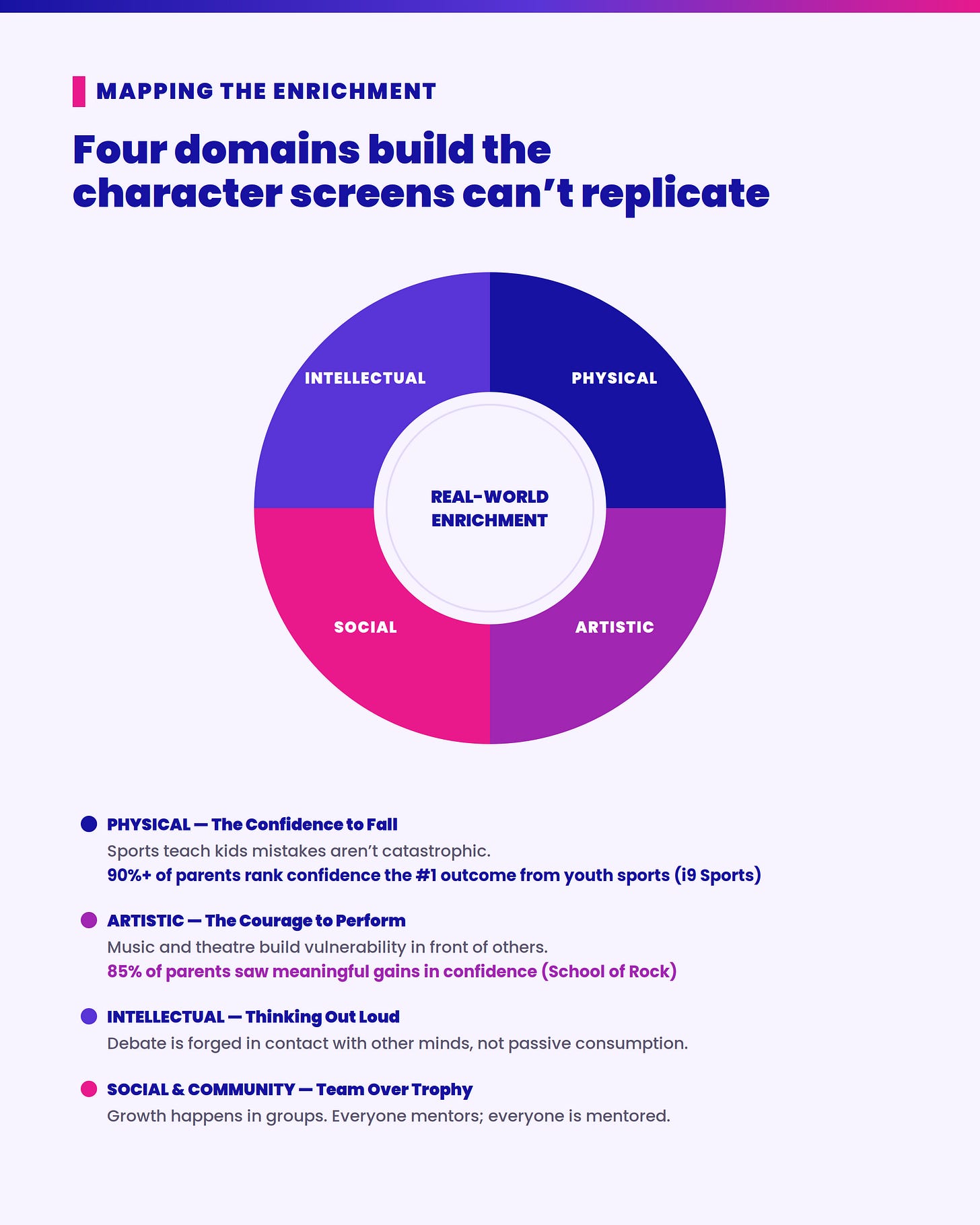
Confidence, resilience, and joy can manifest in single areas of focus. However, our experience at Youth Enrichment Brands is that healthy enrichment is built on exposure in four domains:
Physical development: Sports, outdoor play, movement, and yes, moderate risk-taking — teach something no classroom and no screen can replicate: the confidence to fall. Not just the confidence to fail, which is what we usually talk about, but something more primal than that. The confidence to fall. It is built through skinned knees, not grand lessons. It comes from having another inning, another down, another minute on the clock, and from a childhood in which mistakes are not catastrophic because the game is never that serious. Our data from i9 Sports’ Shaping the Future of Sports for Girls survey bears this out: more than 90 percent of parents ranked confidence among the top outcomes they want their daughters to gain from sports. Not trophies. Not college recruitment. Parents want what is best for their children, even though they may sometimes be misguided. We just need youth programs that reflect it.
Artistic development: Music, theatre, and dance build the experience of taking risks and of being vulnerable in front of other people. A student who walks onto a stage after months of rehearsal, who plays their part in something larger than themselves and feels the audience's response, has done something that cannot be digitally replicated. Our School of Rock Social Impact Study, based on responses from 1,443 parents of current students, found that nearly 85 percent reported meaningful progress in their child's confidence, communication, and ability to engage in group settings. More than 87 percent reported better, more meaningful conversations with their child. These are not musical outcomes, but human ones. The instrument is the mechanism. Healthy social-emotional development is the point.
Intellectual development: Debate, academic clubs, project-based learning, and collaborative problem solving are strongest when they are active and social. The passive consumption of information, however well-curated, does not build critical thinking. Argument does. Discussion does. The experience of defending a position in front of peers who will push back does. Critical thinking develops through engagement with other people. Intelligence is sharpened through dialogue, disagreement, collaboration, and shared discovery—not merely through consuming information, however sophisticated.
Social and community development: What makes these real-world domains work is that individual growth happens in communities. Character is not built in isolation. It is formed through repeated, shared experiences that require cooperation, accountability, and real-time feedback from real human beings. When a child is surrounded by other people—in a rehearsal room, on a field, in a pool with other kids navigating the same uncertainty—they are receiving feedback in a multitude of small ways simultaneously: body language, tone, engagement, laughter, and silence. The constant, overlapping stream of social information is how human beings learn to calibrate themselves. It is how we develop a sense of who we are in relation to other people.
Within these communal environments, something else emerges: collaborative competitiveness. Children learn that although personal accomplishments can be meaningful, what is truly admirable is how you contribute to your team. Everyone gets to be a mentor. Everyone gets to be a mentee. Teaching a child the satisfaction of watching someone else thrive because of their help is not only the right thing to do, but one of the most protective things we can do for a young person’s mental health. A child who adds value to others is a child who does not measure their worth by a scoreboard.
For each of these real-world domains, parents can select activities that maximize confidence, resilience, and joy. Start with your child's interests, not your ambition or your anxiety. Be broad-minded in the consideration set. The best activity for your seven-year-old might be artistic, athletic, nature-based, or something you haven’t thought of yet. But resist the urge to present them with too many options at once. Research on choice paralysis shows clearly that overwhelming children with options produces stress, not enthusiasm. Introduce one activity at a time. Let each one breathe. If it resonates, nurture it; if it doesn’t, try something else. This is experimentation, not failure.
Naturally, parents can’t do this alone. Schools need to integrate ensemble-based arts, team sports, and collaborative project-based learning into the core of the school experience and treat them as essential components. Schools need to build cultures centered on participation and shared identity rather than individual performance and ranking. A child’s day at school should be integrated with experiences that provide the productive discomfort of working alongside people who are different from them, disagreeing and resolving it, failing at something in front of peers, and coming back the next day. All of this becomes much easier if the phone is locked up all day.
Communities must invest in the shared spaces where childhood actually happens. Fields, courts, pools, studios, and rec centers are communal spaces where children can flourish. These are not amenities. They are infrastructure. Create cross-generational mentorship opportunities — safe, structured programs that put young people in sustained contact with adults who are not their parents, who see them differently, who can offer the kind of feedback that only comes from outside the family. Build environments designed to bring kids together, not just keep them occupied. Prioritize access and transportation. A program that exists but cannot be afforded or reached is not a solution.
Policymakers must consider real-world developmental infrastructure as essential. Fund it accordingly. Protect it when budgets tighten. Require it when building new communities. Do not stop at digital regulation but complement it with proactive investment in the real-world experiences that regulation and restriction alone cannot create. Share accountability for children's online safety between parents and the platforms designed to capture their attention. We have to activate and move quickly because we are woefully behind. The data has been clear for years, and the cost of delay is measured in our children’s mental health.
The Character We're Building
The programs are not enough on their own. What determines whether a child walks out of a real-world experience with something durable is not the facility or even the activity. It is what the adults in the room are actively cultivating, and whether the structure of the experience is designed to cultivate it too.
This is where our greatest responsibility lies. Not just in building the spaces where childhood can happen, but in ensuring that what happens inside them is intentionally oriented toward character rather than rankings or performance metrics that toxic achievement culture has trained us to mistake for growth.
Across every domain and every program in the Youth Enrichment Brands family, we are working toward the same outcomes. We believe in safety. The kind that allows children to take constructive risks without fear of humiliation. We believe in curiosity because children have the best chance to discover their true passion when they can experiment and be challenged by a broad array of experiences. We believe in connection — for teammates, opponents, coaches, and instructors to foster friendship, mentorship, and respect. We believe in persistence and the willingness to stay in something hard before it becomes rewarding. We believe in belonging — not as a byproduct of winning, but as a precondition for growth.
These values show up in small moments. It means a coach who responds to a child's mistake not with disappointment but with redirection. It means programming structured around proficiency for every skill level, not just the most talented kids in the room. It means that respect for an opponent is treated as seriously as the score. It means a parent who cheers for the effort, not just the outcome. It means a teammate who stays after practice to help someone struggling with a skill or help them just put away their gear.
At i9 Sports, we ask our parents to sign a code of conduct, not to impose rules but to make explicit what these programs are trying to do. The language of that code is deliberate: we encourage parents to be there for their children, not at them. That distinction between presence and pressure, between witnessing and judging, is one of the most consequential things an adult can get right at a sideline.
These values are not decorative. They are operational. They are what we are building, through every practice, every performance, and every game.
The World We're Building
We have spent a decade watching children watch things. Watching screens. Watching other people's stories. Watching content designed to be consumed. Watching for signals from others about what their passions should be.
It is time to put the dark days of isolation and detachment behind us in favor of an era of participation. We know what it takes.
I’ve seen it in rehearsal rooms, pools, and on fields. I’ve seen it in the kid who walks offstage after their first real performance and experiences an unfamiliar joy. I have seen it in a kid who finds their favorite sport through discovery, versus embracing just one sport because of parental expectations. I’ve seen it in the parents who experience the deep gratification of prioritizing an activity solely based on their child’s interest.
Every generation is entrusted with shaping the childhood of the next. Ours has inherited that responsibility at a moment when the forces competing for children's attention have never been more powerful. That makes our responsibility even greater—not simply to protect childhood, but to create the conditions in which it can flourish.
Welcome to Our Brands




Welcome to Our Brands


.png)